The Story Behind: Amazing Grace
Amazing grace, how sweet the sound, that saved a wretch like me.
Wretch indeed. The man who wrote those words did not reach for them lightly, and he did not exaggerate. Before John Newton was a minister, he was a slave trader who openly mocked the very God he would one day serve. His is one of those rare lives where the distance between the man and the mercy is so vast that the mercy becomes the only explanation. That is the whole point of the hymn. Grace is not earned. It is given, freely, to those who could never deserve it, and no one is beyond its reach.
Who Was John Newton?
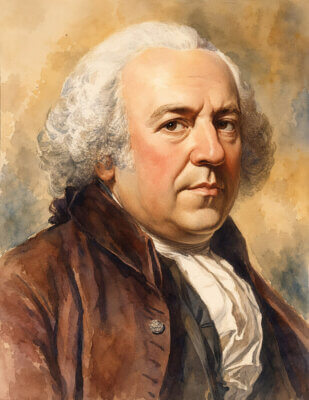
John Newton was born in London, 1725. His mother was a devout woman who taught her son Scripture and hymns and prayed he would one day enter the ministry. She died before Newton was seven years old, and with her went much of the faith she had planted. The boy went to sea young, for his father was a ship commander, and the years that followed hardened him into a profane and rebellious young man. He was pressed into service in the Royal Navy, deserted, was flogged for it, and eventually found his way into the cruelest trade the ocean had to offer: the buying and selling of human beings. In West Africa he sank lower still, for a season enslaved himself, hungry and humiliated under the man he served. Few lives have begun so far from grace.
The Storm That Brought John Newton to His Knees
Newton would have been used to storms at sea, for most of his life had been spent there. But the storm that struck his ship, the Greyhound, in March of 1748 was something else entirely. It tore at the vessel through the night and threatened to send every man aboard to the bottom. It was this storm that finally brought Newton to his knees, pleading with the God he loved to mock to spare him and his crew. As the story has long been told, Newton first felt the grace of God that night when another man took his place on deck; within minutes the sea swept the spot clean, and the crewman who had replaced him was lost. Newton lived. He would mark that day for the rest of his life as the hour his hard heart first began to soften.
From Slave Trader to Minister
The storm planted a seed, but a seed it remained for years to come. Newton did not abandon the slave trade after that night; he continued in it for six more years, even captaining slave ships of his own. Only in time, and through illness that forced him from the sea, did he leave the trade behind. Then the seed began to sprout. Newton took up the study of theology with the same energy he had once given to the ocean, and in due course he was ordained in the Church of England and given the curacy of the little market town of Olney. So, what became of the profane sailor? Did he hide his past? Did he bury his sins in silence? No, he stood in an Olney pulpit and made his own ruin the very proof of God’s mercy.
How “Amazing Grace” Was Really Written
Here the familiar story needs correcting, for many believe Newton wrote Amazing Grace on the deck of that storm-tossed ship. He did not. The hymn came some twenty-five years after the storm, in the quiet of Olney, for an ordinary Sunday. The Library of Congress places its writing firmly in that later season, not aboard the Greyhound.
In the final days of December 1772, Newton was preparing a sermon for New Year’s Day. His diary from that month records him “composing hymns,” and on the first of January, 1773, he preached from 1 Chronicles 17:16 and 17, the prayer of King David, astonished that God would bless a man so undeserving. The Cowper and Newton Museum preserves both entries. The hymn Newton wrote to accompany that sermon was not called Amazing Grace at all. He titled it Faith’s Review and Expectation, a backward look at mercy already received and a forward look at mercy still promised. The Museum of the Bible draws those two motions straight from Newton’s sermon notes.
It was never meant to be famous. Newton wrote it for the lace makers, farmworkers, and tradespeople of his parish, using his own wrecked and rescued life as the lesson. Years before, he had written in his diary that if God ever let him preach, “grace, free grace, must be the substance of my discourse.” In Amazing Grace, that is exactly what he gave them.
The Meaning Behind the Lyrics
Newton’s original hymn had six stanzas, every one of them printed in Olney Hymns in 1779. The first carried the line we all know:
Amazing grace! how sweet the sound,
That saved a wretch like me!
I once was lost, but now am found,
Was blind, but now I see.
The opening stanzas tell of conversion: grace that saves, grace that teaches the heart to fear and then relieves that very fear, grace that opens blind eyes. The third stanza looks back across the believer’s hard road:
Through many dangers, toils and snares,
I have already come;
‘Tis grace hath brought me safe thus far,
And grace will lead me home.
Those dangers, toils, and snares were no abstraction for Newton. They were the navy, the slave coast, the storm, the long years of rebellion. The stanzas that follow turn from his past to God’s promises, and then beyond death itself to eternal security. That is the review and the expectation Newton named.
The famous last stanza, When we’ve been there ten thousand years, Newton never wrote at all.
These lines wandered into the hymn from elsewhere in early American hymnody, were carried along in the religious culture that surrounded Harriet Beecher Stowe’s Uncle Tom’s Cabin, and were finally joined to Newton’s text in a 1910 hymnal. Hymnary traces that journey. Familiar as they are, they belong to the hymn’s adopted family rather than to its author.
There is one more word worth noting: wretch. Some later editors found it too harsh and softened it, one rendering replacing “saved a wretch like me” with “freely saved me.” The change is well documented. But to remove the wretch is to remove the point. Newton meant the word. He had earned it, and never was it more freely answered.
The Tune We All Know (New Britain)
For all its fame, Amazing Grace was published with no music whatsoever. Olney Hymns printed words alone, as was the custom of the day, leaving congregations to sing the verses to whatever common tune they already knew. For its first decades the hymn drifted from melody to melody and settled on none.
The tune now inseparable from the words is called New Britain, and it is not English but American. It rose out of the shape-note singing of the American frontier, a pentatonic melody printed in tune books of the late 1820s. The decisive moment came in 1835, when William Walker paired Newton’s text with New Britain in his collection The Southern Harmony and Musical Companion. That book sold hundreds of thousands of copies and carried the marriage of words and tune across the country. The Sacred Harp followed in 1844, and the pairing was sealed for good.
A popular legend holds that the melody is old Scottish bagpipe music. It is a fitting tale, for the tune does sing beautifully on the pipes, but the evidence points to American shape-note roots. The strong bagpipe association came much later, after a famous recording in 1972.
From an Olney Hymnbook to the Whole World
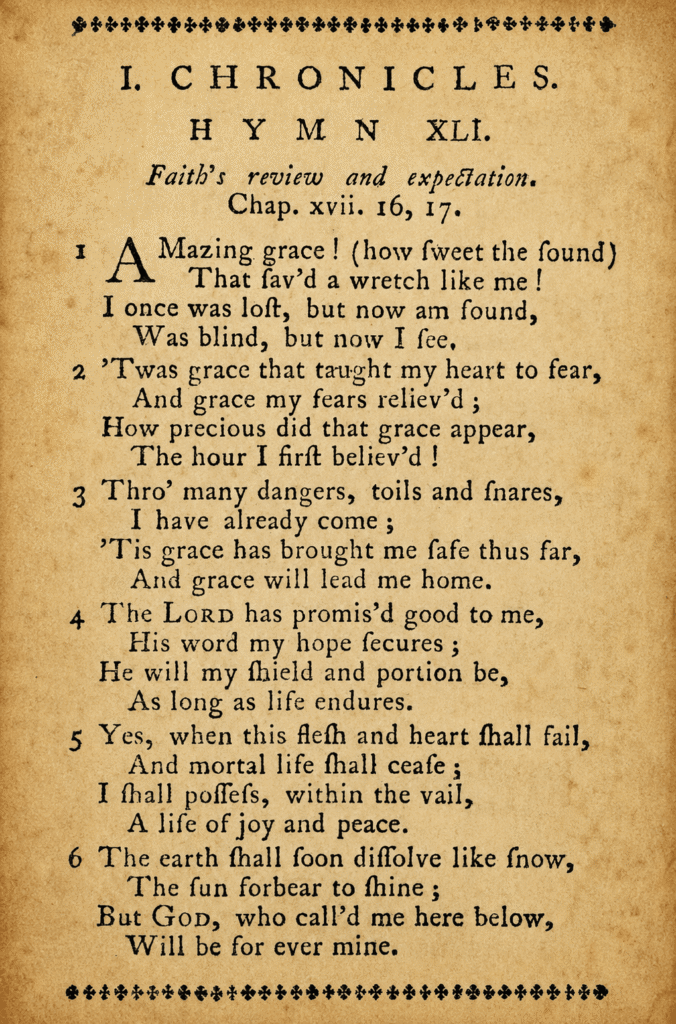
When Amazing Grace first appeared in Olney Hymns in 1779, it did not stand out. It sat near the bottom of page fifty-three in a collection of more than four hundred pages, one quiet entry among hundreds. No one at the time would have guessed which one the world would remember.
It was in America that the hymn truly took root. Editions of Olney Hymns crossed the Atlantic to New York, Philadelphia, and New Jersey, and the text spread quickly through Baptist, Reformed, and Congregational churches and the great revival meetings of the early 1800s. Its American spread outpaced its English one by far. Even so, its greatness was not obvious to all. As late as 1907, the respected Dictionary of Hymnology dismissed it as “far from being a good example of Newton’s work.” History would render a very different verdict.
John Newton, Abolition, and William Wilberforce
Newton never forgot what his hands had done. “It will always be a subject of humiliating reflection to me, that I was, once, an active instrument in a business at which my heart now shudders,” he wrote, and in his later years he lent his testimony to the fight against the very trade he had once profited from.
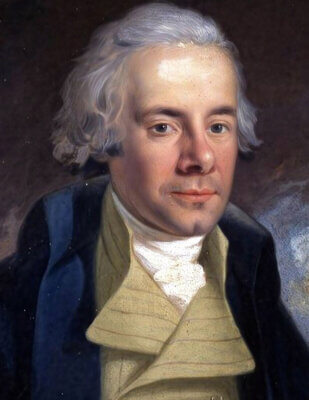
His witness fell on one young man in particular. William Wilberforce had attended Newton’s church as a boy and later sought out the old minister for counsel. Under Newton’s influence, Wilberforce gave his life to the work of ending the slave trade, and his labor as an English lawmaker led in time to freedom for over 800,000 slaves.
It is worth being honest here, for the two stories are often blurred into one. Amazing Grace was not written as an abolitionist anthem; it was written for a New Year’s sermon years before Newton took up the cause publicly. No direct line connects the hymn’s composition to his later campaigning. Yet both the hymn and the abolition flowed from the same redeemed life. The man who once trafficked in human souls spent his final years singing of free grace and laboring to set captives free. That is no accident. That is what grace does to a man.
How “Amazing Grace” Became a Global Anthem
In the centuries since, Amazing Grace has traveled further than any hymn of its kind. It was first recorded in 1922, and from there it crossed every border music knows. Judy Collins sang it without accompaniment in 1970, and her unlikely hit carried the old hymn into popular culture for a new generation. Her recording was later named to the National Recording Registry. Two years on, Aretha Franklin lifted it into gospel glory while the Royal Scots Dragoon Guards sent it soaring on the bagpipes, and the song belonged at once to the church, the concert hall, and the radio. In 2006, Chris Tomlin gave it new wings for the modern church with “My Chains Are Gone.”
And when grief came to Charleston in 2015, after nine believers were murdered in their own church, it was Amazing Grace that a President began to sing over their caskets, and a nation sang with him. The moment was recorded in the official transcript of that eulogy.
Today the hymn appears in more than 1,700 hymnals and has been carried into dozens of languages, from Spanish and Korean to Navajo, Muscogee, and Cree. What began as one minister’s quiet New Year’s testimony has become, in the truest sense, a song for all the earth.
John Newton was a wicked man who deserved death at sea. But the heart of God’s grace is that it is never earned; it is a gift made of pure, undeserved love. This is perhaps the most important truth any soul can grasp, and it is why Amazing Grace drew so many people when Newton first wrote it, and why it draws us still.
Newton chose his own epitaph, and it tells his whole life in a single breath: “John Newton, Clerk, once an infidel and libertine, a servant of slaves in Africa, was, by the rich mercy of our Lord and Saviour Jesus Christ, preserved, restored, pardoned, and appointed to preach the faith he had long laboured to destroy.”
Preserved. Restored. Pardoned. The same grace still sounds, sweet as ever, for every wretch who will hear it.
A Postscript: Where Did That Last Verse Come From?
Sing Amazing Grace today and the hymn almost always ends the same way:
When we’ve been there ten thousand years,
Bright shining as the sun,
We’ve no less days to sing God’s praise
Than when we’d first begun.
It is the verse that lifts the whole hymn into glory, and Newton never wrote a word of it. His own final stanza, printed in Olney Hymns in 1779, looked toward heaven from a different angle:
The earth shall soon dissolve like snow,
The sun forbear to shine;
But God, who call’d me here below,
Will be forever mine.
So where did the famous ending come from? The trail is old and winding. The closest known ancestor belongs to a 1784 hymn by Elhanan Winchester, who wrote that the saints, after ten million years in heaven, would have no less days to sing God’s praise than when they first begun. Six years later, in 1790, the wording we now know appeared in A Collection of Sacred Ballads, tacked onto an old hymn called “Jerusalem, my happy home.” The stanza, it turned out, was a wandering thing, easy to attach to any hymn that shared its meter, and wander it did.
It came to Amazing Grace through an unlikely door: a novel. In 1852, Harriet Beecher Stowe set the stanza beside Newton’s verses in Uncle Tom’s Cabin, where the dying Uncle Tom sings them together. That pairing lived in print and song for decades before any hymnal made it official. Not until 1909, in a collection arranged by E. O. Excell, were the two finally bound together on the page, and the version Excell printed is very nearly the one we sing today.
So the next time the congregation rises for that final, soaring verse, know that you are singing a small piece of borrowed glory: a stanza that drifted across more than a century and three different hymns before it came to rest, at last, in the most beloved hymn of all.
Download sheet music, chord charts, tracks and multitracks for Amazing Grace exclusively here at Hymncharts.com and Worshiphymns.com. You won’t find this arrangement on any other websites.
43 Million Streams